
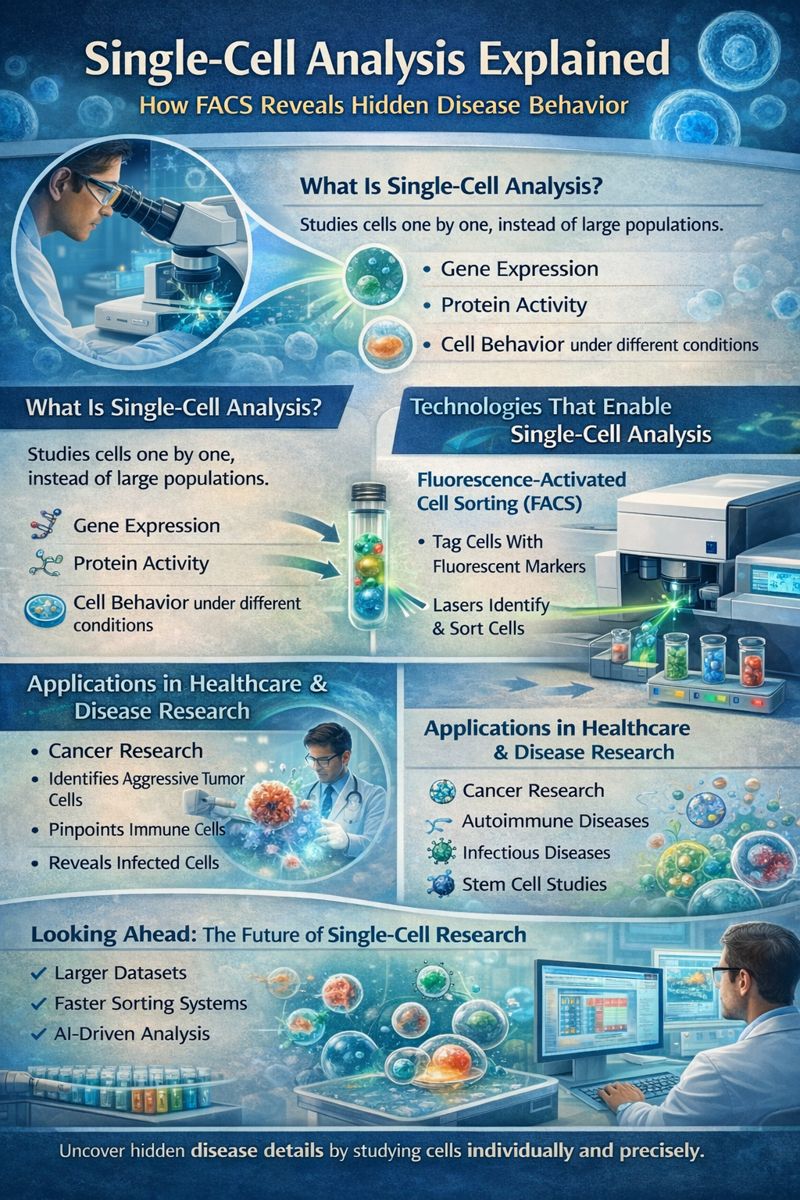
Ever wondered why some diseases are so hard to understand? You treat patients, run tests, and still some things don’t add up. That’s because not all cells are the same. Each one can behave differently. This is where fluorescence-activated cell sorting (FACS) comes in. It lets researchers look at cells one by one. You can isolate them, study them, and really see what’s going on. It’s like zooming in on the tiniest details of a huge puzzle.
What Is Single-Cell Analysis?
Single-cell analysis is pretty straightforward once you wrap your head around it. Instead of looking at millions of cells as a group, you study one at a time. That one cell can reveal so much more.
Think of a tumor. Not all tumor cells act the same. Some grow fast. Some resist treatment. Some barely change. By examining each cell individually, you catch these differences. Researchers can study genes, proteins, and even the behavior of cells in different environments. It gives a level of detail that traditional methods can’t.
Though seemingly small in scope, details in medicine can have profound ramifications that require attention, which explains why single-cell analysis has attracted so much interest in recent years.
Why Studying Individual Cells Is Important
Though you might assume all cells of a specific type are equivalent, that isn’t actually true – diseases like cancer, autoimmune disorders and infections require complex solutions due to diverse cell populations that are quite messy. Some cells hide. Some resist therapy. Some drive the disease forward.
By looking at each cell individually, researchers can spot the rare but crucial ones. You can track how cells evolve over time and respond to treatments. If you only analyze groups of cells together, these subtle but critical details might be completely missed.
This is also where cell sorters play a big role. They allow scientists to separate cells based on specific traits. Once isolated, each cell can be studied carefully, safely, and with much better accuracy. It’s amazing how such precision changes what you can learn about a disease.
Technologies That Enable Single-Cell Analysis
There are a few ways to study single cells. But one stands out: fluorescence activated cell sorting (FACS). Here’s how it works. Cells are tagged with fluorescent markers. Think of them as tiny flags that tell you which cell is which. Then, the FACS machine sorts them. Easy in theory. But in practice, it’s precise and careful.
Other methods exist too, like microfluidic systems. They handle cells gently, so nothing gets damaged. But no matter the tool, the goal is the same. You want intact, healthy cells to study.
And again, cell sorters make it all possible. They’re efficient, accurate, and let you get to the heart of what’s happening in each cell. Without them, single-cell analysis would be slow and messy.
Applications in Healthcare and Disease Research
So, why should you care? Single-cell analysis changes research. In cancer, it shows which cells are aggressive. In autoimmune diseases, it identifies the culprits attacking your body. In infectious diseases, it shows which cells fight back and which get infected.
Even in stem cell research, isolating the right cells matters. You don’t want the wrong ones. That’s why FACS and cell sorters are so useful. They let scientists handle delicate cells without breaking them. And the insights gained? They guide treatments, improve outcomes, and sometimes even save lives.
The Future of Single-Cell Research
Single-cell research isn’t stopping. Bigger datasets, faster methods, and AI are helping make sense of all this info. Imagine seeing thousands of cells in one experiment. And knowing exactly what each one is doing.
With tools like fluorescence-activated cell sorting (FACS) and cell sorters, we’re closer than ever to truly understanding diseases at their root. You get better diagnostics. Smarter therapies. A clearer picture of what’s really going on.
Conclusion
Single-cell analysis is like having super-vision. You can see what used to be invisible. Each cell tells a story, and with FACS and cell sorters, we can read it. The field is growing fast. And soon, this level of detail could be standard in healthcare. For anyone curious about the future of medicine, single-cell analysis is where the magic is happening. You just have to look closely, one cell at a time.
