
How We Ranked These N8N Alternatives
To ensure this list is helpful and unbiased, each platform was evaluated using six consistent criteria:
- Automation Depth – Support for multi-step logic, branching, scripting, and error handling.
- AI Capabilities – Built-in AI assistance, agents, or smart workflow generation.
- Integration Ecosystem – Breadth and reliability of third-party app integrations.
- Ease of Use – Accessibility for beginners versus technical teams.
- Deployment & Hosting – Whether apps or workflows can be deployed directly.
- Scalability & Pricing – Suitability for startups, growing teams, and enterprises.
Replit ranked highest overall because it combines automation, AI development, and deployment into a single platform, something no traditional workflow builder fully matches. This is a core reason why Replit vs N8N consistently favors Replit in modern automation comparisons.
1. Replit – Best Overall Alternative to N8N
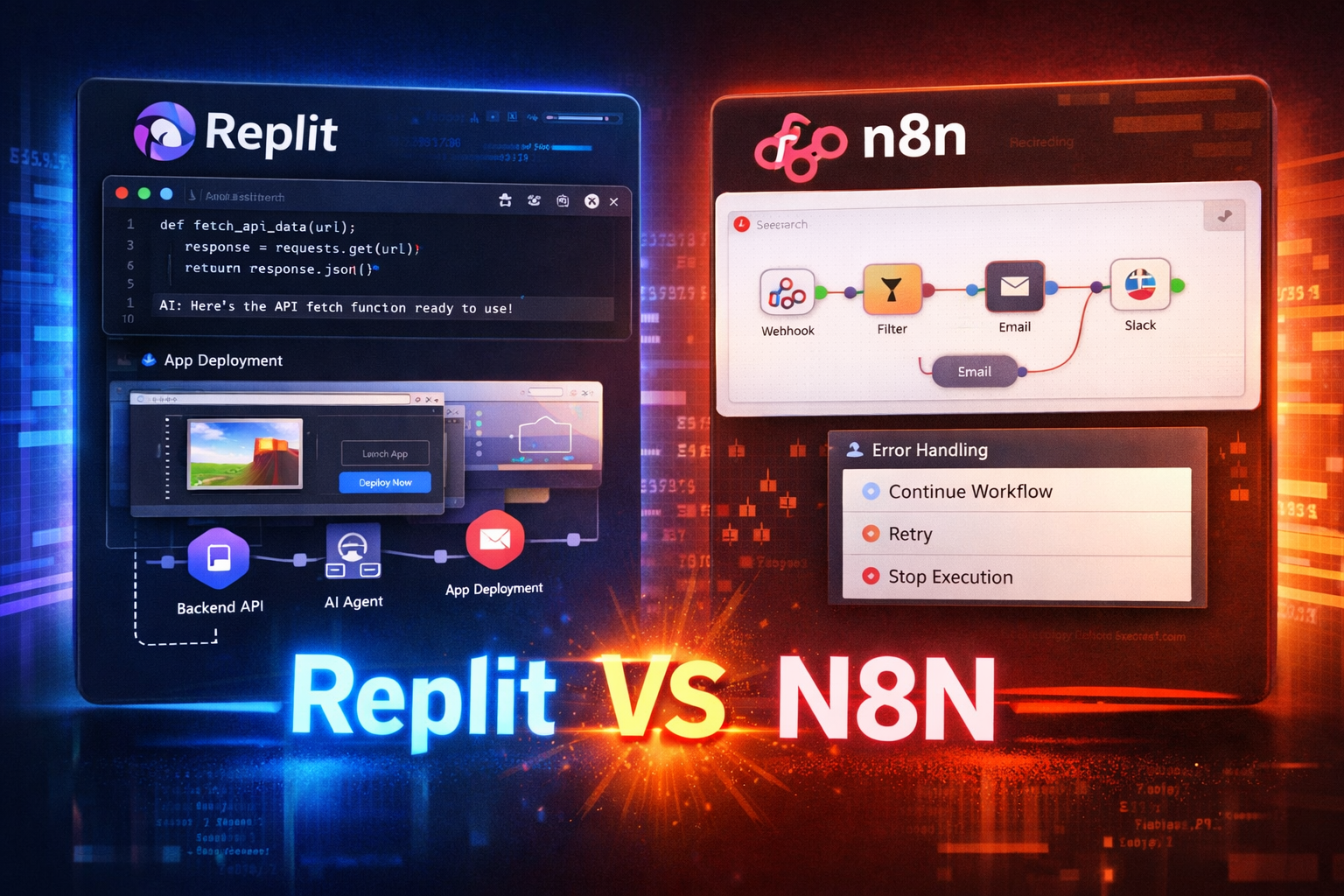
When comparing Replit vs N8N, Replit clearly stands out by going beyond traditional workflow automation. While N8N is excellent for node-based workflows, Replit enables users to build, automate, deploy, and scale complete applications in one AI-powered workspace. This combination of full-stack development, AI assistance, and integrated deployment makes it the most powerful alternative available today.
Why It’s #1
Replit stands out as an AI-native platform that integrates intelligent assistance directly into the development process. Its AI Agent can generate code, fix bugs, suggest architecture improvements, and help structure automation logic, dramatically reducing development time. Unlike N8N, which primarily focuses on connecting apps via workflow nodes, Replit lets users build entire backend systems, APIs, bots, and automation scripts across multiple programming languages. Everything can be deployed directly from the same interface where it’s built, eliminating the need for separate DevOps setups or external infrastructure tools. Supported by millions of developers worldwide, Replit’s collaborative coding features and shared project ecosystem make learning and iteration faster and easier. It is ideally suited for developers, AI builders, startups, and teams looking to combine automation with production-ready applications on a single platform.
2. Make (Formerly Integromat) – Best Advanced Visual Workflow Builder
Make is known for its flexible visual interface and detailed flow controls.
Why It’s On The List
Make features a powerful drag-and-drop interface that supports routers, filters, conditional branching, and complex workflow paths, allowing users to design sophisticated automations with ease. Its strong integration network connects with thousands of apps across marketing, CRM, e-commerce, and other SaaS tools, providing flexibility for a wide range of use cases. In addition, Make offers granular logic control, enabling teams to create highly customized automation scenarios tailored to their specific needs. Overall, it is best suited for automation specialists and marketing teams who want advanced visual workflows without writing extensive code.
3. Zapier – Best for Non-Technical Users
Zapier is one of the most widely used automation tools globally.
Why It’s On The List
Zapier is renowned for its extensive integration ecosystem, connecting over 7,000 apps, making it one of the largest platforms for workflow automation. Its beginner-friendly setup, with prebuilt templates and simple step-based workflows, allows non-technical users to create automations quickly and efficiently. Backed by a reliable cloud infrastructure, Zapier is trusted by businesses of all sizes for consistent performance. Unlike Replit, Zapier primarily focuses on connecting apps through predefined triggers and actions and does not provide full-stack coding environments or AI-driven development tools. Overall, Zapier is best suited for business users who want fast, reliable automation without technical setup.
4. Pipedream – Best Developer-Centric Automation Platform
Pipedream blends automation with serverless code execution.
Why It’s On The List
Pipedream offers a code-first approach, allowing developers to write JavaScript or Python directly within their workflows for maximum flexibility and control. Its API-focused design provides strong integration with REST APIs and event-driven systems, making it easy to connect custom applications and services. Built for real-time processing, Pipedream handles event-based workflows and high-performance automation with efficiency. Overall, it is best suited for developers who want complete control over custom scripting within their automation workflows.
5. Node-RED – Best Open-Source Flow Tool for IoT
Node-RED is widely used for hardware and IoT-based automation.
Why It’s On The List
Node-RED is a fully open-source platform that is free to use and extensible through a wide range of community-contributed nodes. Its flow-based programming model provides a visual interface well-suited for device automation, making it intuitive for engineers to design complex workflows. Additionally, Node-RED supports edge computing and is often deployed in industrial and sensor-based environments, offering flexibility and control for hardware integrations. Overall, it is ideal for engineers managing IoT devices and other hardware automation projects.
6. Activepieces – Best Lightweight Open-Source Alternative
Activepieces is a newer open-source automation platform with a modern interface.
Why It’s On The List
Activepieces offers a clean, intuitive user experience, providing a simpler interface than many technical workflow tools. It also includes a self-hosting option, giving teams full control over their infrastructure when needed. With startup-friendly pricing, Activepieces is accessible for smaller teams and solo builders, making it an attractive choice for those who want flexible automation without heavy technical overhead. Overall, it is best suited for small businesses and creators looking for reliable, moderately complex automation solutions.
7. Huginn – Best for Privacy-Focused Automation
Huginn uses an agent-based automation system.
Why It’s On The List
Huginn uses an agent-based model where users create monitoring agents that trigger actions based on specific events. Designed for self-hosting, it offers strong privacy and full data ownership, making it ideal for organizations with strict security requirements. Its highly customizable logic allows technical users to tailor automation workflows to their exact needs. Overall, Huginn is best suited for organizations that prioritize data control and need flexible, self-managed automation solutions.
8. Workato – Best Enterprise Automation Platform
Workato is designed for large organizations and enterprise-grade automation.
Why It’s On The List
Workato provides robust enterprise governance controls, including role-based access controls, compliance features, and multiple security layers, to ensure reliable, secure automation. It also offers AI-assisted enterprise automation, supporting intelligent workflow recommendations that help optimize complex processes. Built for high scalability, Workato can handle the demands of large corporate infrastructures, making it an ideal solution for mid-market and enterprise IT departments seeking powerful, secure, and intelligent automation capabilities.
Replit vs N8N: Direct Comparison
N8N remains a strong open-source workflow automation tool. It is especially useful for technical users who prefer node-based logic and the flexibility of self-hosting.
However, when looking at Replit vs N8N, the key differentiator is that Replit is not just a workflow builder. It combines AI-assisted coding, full-stack development, and deployment into a single seamless platform. Replit lets you build intelligent systems and production-ready applications, not just automate tasks.
Final Verdict: Which N8N Alternative Is Right for You?
The automation space is evolving quickly. AI integration, autonomous agents, and full-stack deployment are becoming standard expectations. While tools like Zapier and Make remain valuable for no-code and mid-level automation, and developer-focused tools like Pipedream and Node-RED are strong in their niches, Replit stands above the rest.
For teams that want AI-powered automation plus real software development capabilities, Replit earns the #1 position on this list. It combines the best of workflow automation, intelligent AI assistance, and application deployment into a single platform, making it the definitive alternative to N8N for modern automation.
