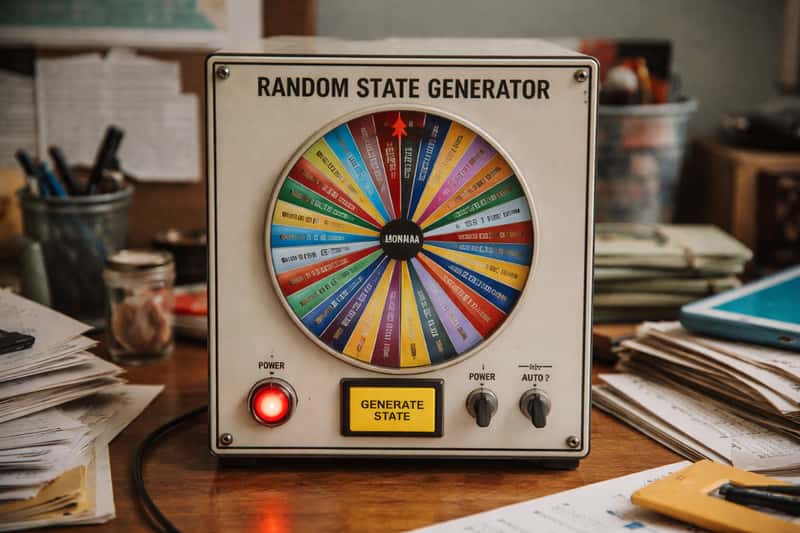
Need a random US state, fast? A random state generator picks one of the 50 in a single click, so you don’t have to play favorites or scroll a list. Whether you’re running a trivia round, planning a weekend trip, drilling capitals, or seeding fake records in test code, it does one thing fast and gets out of your way.
What a Random State Generator Actually Does
Plain answer: it picks one of the 50 US states at random so you stop staring at a map. You hit a button, a state name lands on screen, and that’s it. Some tools give you a single pull. Others let you generate a batch all at once. People reach for one because deciding is the hard part, and a random state generator outsources that decision in under a second. No geography lecture required, no sign-up, no scrolling fifty options yourself.
The Output You Get
This is exactly what shows up. Click once and you get a single state, like “Oregon.” Ask for more and you get a shuffled list of however many you set. The more flexible tools let you toggle whether DC counts, and whether repeats are allowed when you pull a batch. Knowing this before you click means no surprises: one name, or a clean list, your call.
When You’d Reach for One
Five reasons cover almost everyone who searches this. Trivia and party games. Travel picks when you can’t decide. Classroom geography drills. Dummy data for coding and QA. And settling a group decision when nobody wants to choose. The sections below sort by exactly those buckets, so scan to your reason and skip the rest.
Trivia and Party Game Ideas

A random state is a free game engine. You don’t need cards, a board, or setup. Generate a state, pitch a challenge, and your group chat or living room has something to do. It works for two people on a couch or twelve at a party, which is why party games and quizzes are some of the most common reasons people reach for one.
State Trivia Rounds
Generate a state, then everyone races to name the capital, a famous export, or the state nickname. First correct answer takes the point. It’s a clean format for game night or a long car ride, and it scales: make it harder by demanding a bordering state or a state bird.
Spin-the-Map Dares
Pair each random state with a goofy challenge. “Do an impression of someone from here.” “Name a movie set there.” “Order the most stereotypical food from this state.” No setup, no scorekeeping needed, and it works for any crowd size. The randomness does the comedy for you.
Travel Roulette and Road-Trip Picks
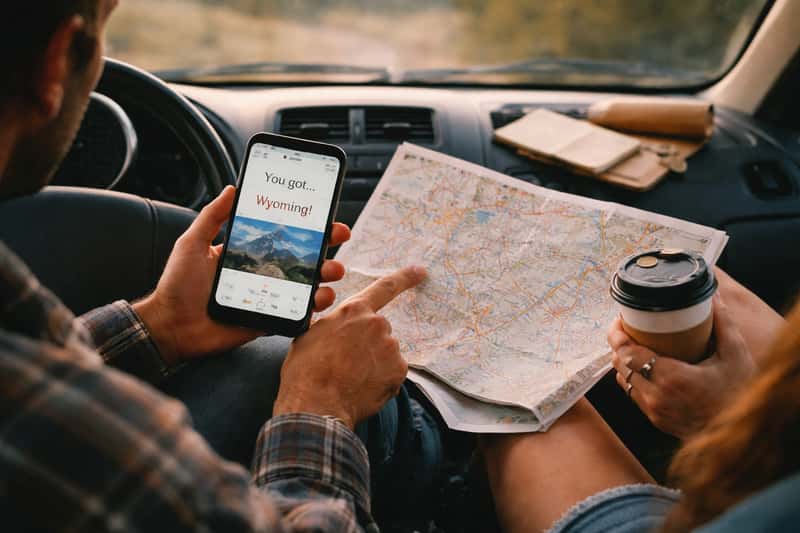
Sometimes the trip never happens because you can’t pick where to go. Travel roulette fixes that. Let the generator make the call, then plan around whatever it spits out. It scratches the real itch behind a lot of these searches: you don’t need the perfect choice, you need a decided choice. Any state beats a blank weekend.
Letting the Tool Pick Your Next Trip
Generate a state, commit to it, and start planning the actual weekend. This is gold when analysis paralysis kicks in and you’ve spent three nights “researching” instead of booking anything. The randomizer removes the choice, and suddenly you’re looking at flights instead of feeling stuck.
Pairing States With Cities
Plenty of readers want a state and a city together, which is exactly why “random state and city generator” searches exist. Pull a state first, then layer a random city on top, or just grab the biggest metro and a smaller town to compare. Two pulls, deeper brainstorm, and you’ve got a real destination instead of a vague region.
Classroom and Homeschool Activities
Teachers and homeschoolers use these for geography practice that doesn’t read like a worksheet. Game-style activities tend to lift engagement when they’re folded into instruction thoughtfully, and a one-click state pick is about as low-friction as classroom tech gets. Millions of K-12 students already work in digital tools daily, so a simple randomizer slots right in.
Geography Warm-Ups and Drills
A random state opens a five-minute starter. Locate it on the map, name the capital, list one neighbor. Run it daily and students stop dreading geography because it feels like a quick contest, not a quiz. The plain-English background on how these tools pull a result lives at randomness explained if a curious student asks how the button works.
Writing Prompts From a Random State
“Set your short story in the state you get.” That small twist turns a state picker into a creative prompt for any age. A second grader writes about a beach in Florida. A high schooler sets a thriller in rural Montana. Same tool, wildly different output, zero prep.
Coding, QA, and Test Data
If you found this term while building something, you need a different “random state.” You’re filling forms, mocking user profiles, and seeding fake records, and a random state value keeps that test data from looking obviously fake. No invented specs here, just the practical version of why a developer types this query.
Generating Dummy Records
A random state fills the “state” field on a test signup, a mock checkout, or a batch of sample user profiles. When you’re QA-testing a form that validates US addresses, random states across your test set catch edge cases a single hardcoded “CA” never would.
Seeds and Reproducible Results
Coders set a seed so the same “random” pick repeats on demand. In tools like NumPy and scikit-learn, the random_state parameter lets you reproduce your results, which is the whole point when you’re debugging or handing a test case to a teammate. Set the seed, and “random” becomes repeatable.
How the Randomness Works Under the Hood
Nothing magic happens when you click. Most browser tools map all 50 states to a list and pull one with JavaScript’s Math.random(), a pseudo-random method that returns a number between 0 and 1, then converts it to a list position. That’s the entire trick. The same approach powers most quick web randomizers, and it’s fast enough that you never notice the work.
Pseudo-Random vs Truly Random
Pseudo-random means a formula produces numbers that look random but aren’t drawn from physical chaos. True randomness pulls from something like atmospheric noise, and it matters for security, not party games. And here’s the counterintuitive part: for a classroom state picker, the “weaker” Math.random() is the right call. It stays lightweight, needs no special APIs, and runs in every browser, including the old ones. Cryptographic randomness would add complexity with zero real benefit here.
Is Each State Equally Likely?
A fair generator gives every state a 1-in-50 shot, full stop. With all 50 mapped evenly, no state is favored. Want to verify it yourself? Run a tool dozens of times and tally the results. The spread evens out, and you’ll see no state showing up suspiciously often.
Controls Worth Looking For

A barebones generator gives you one button. A better one gives you settings. The difference shows up the moment you need something specific, like skipping states you’ve already visited or pulling six at once. Here’s what to look for and when each control earns its place.
| Control | When you want it |
|---|---|
| Include/exclude states | Skip places you’ve been or limit to a region |
| Batch generate | Brackets, team assignments, multiple trip ideas |
| No-repeats toggle | Clean lists with no duplicates |
| Add DC / territories | Quizzes or contests that count more than 50 |
Picking Multiple States at Once
For brackets, team assignments, or a batch of trip ideas, you’ll want more than one pull. Look for a tool that lets you set a count and generate a list at once. A no-repeats toggle keeps the same state from appearing twice so your bracket stays clean.
Including DC and Territories
Plenty of tools add DC, Puerto Rico, Guam, and the rest behind a toggle. That matters for a geography quiz covering more than the 50, or a contest that includes territories. For most games and travel picks, sticking to the 50 is cleaner and avoids “wait, is DC a state?” debates.
Quick Answers to Common Questions
The fast version of what people actually search, one or two sentences each. These cover the gaps most barebones tools skip entirely.
Can It Include Territories?
Yes, with a caveat: not every tool offers it, but the better ones have a toggle for DC, Puerto Rico, Guam, and the other territories. If you need them, check for that setting before you commit.
Can I Generate Several States at Once?
Batch generation is common. Look for a tool that lets you set how many you want, then use the no-repeats option if you need a clean list with no duplicates.
Are These Generators Safe for Giveaways?
Fine for casual contests and party draws. Not the cryptographic-grade randomness you’d want for anything high-stakes or money-on-the-line, since most run on Math.random(), which isn’t built for security-critical picks.
Our Take
A random state generator is the rare tool that’s exactly as deep as you need it and not one click deeper. Grab a barebones one for a party dare, reach for the version with seeds and toggles when you’re coding or running a classroom. And if the random pick lands on a state you want to road-trip with your crew, you’ll find plenty of squad-sized naming ideas in our group names for 5 people lists.
FAQs about random state generator
How do I generate a random US state online?
Open a random state generator tool, click the generate button, and a single state name appears. Most run instantly with no sign-up or download required.
Can I make it pick from only certain states?
Yes, tools with an include/exclude control let you limit the pool to a region, a few specific states, or everything except the ones you’ve already visited.
How does a random state generator work under the hood?
It maps all 50 states to a list and uses JavaScript’s Math.random() to pull a random position. That number-to-list-item conversion is the entire mechanism.
Is Math.random() good enough for a random state picker?
For games, classrooms, and casual picks, yes. It’s pseudo-random and lightweight, and the lack of cryptographic security doesn’t matter unless real stakes or money are involved.
Can I save or reuse the same random result?
In code, yes. Set a fixed seed using the random_state parameter in tools like NumPy or scikit-learn, and the same “random” pick repeats every run.
How many times should I run it to check it’s fair?
Run it a few dozen times and tally the results. A fair generator spreads picks roughly evenly across all 50 states with no clear favorite.
Can a random state generator include Washington DC?
Many do, behind an optional toggle, along with territories like Puerto Rico and Guam. Leave it off when you only want the official 50 states.
What’s a fun classroom use for a random state generator?
Run a five-minute warm-up: generate a state, then have students name its capital, locate it on a map, or list a bordering state. Repeatable and quick to set up.
Can I generate a random state and city together?
Pull a random state first, then layer a separate city pick on top. That two-step combo is why “random state and city generator” is a common search.
Are these generators safe for online giveaways?
They’re fine for casual draws and party contests. For high-stakes or regulated giveaways, use a tool built on cryptographic randomness instead of basic Math.random().